It’s the customer, stupid
Internet Retailer Best of the Web 2007
BestBuy.com
Crutchfield.com
Dell.com
GameStop.com
JR.com
Palm.com
TigerDirect.com
YesAsia.com
Sales of computers and electronics account for a major piece of the e-commerce pie. There are myriad sellers in this category, and merchants that want to rise to the top have to undertake significant efforts that help keep their brands in consumers’ heads and make their sites as informative and easy to use as possible. In computers and electronics, customer loyalty is critical.
Because computers and electronics are far more complex than teddy bears or flowers, providing practical, understandable product information is important. TigerDirect Inc.’s vice president of creative Dan Brown, for example, is most concerned about conversions: not just converting shoppers into buyers but converting buyers into loyal customers. So his team routinely works to develop creative content for TigerDirect.com, building significantly on a base of specs and product information it receives from manufacturers. And they’re adding new content from some 40 manufacturers, enriched by technology provider WebCollage Inc.
J&R Electronics Inc. also wants to give its online customers much more. Late this year it began migrating its handsome and practical site to a new e-commerce platform, which will support hundreds of online videos of J&R’s store salespeople explaining the intricacies of consumer electronics products, bringing information to life. “This will bring one of our greatest assets, our sales people, to the web,” a company spokesperson says.
It’s one thing to have an abundance of information; it’s another thing to be able to find it. Like J&R Electronics, Palm.com has placed a premium on enabling shoppers to very quickly get to specific information, of which Palm.com has the proverbial tons. A shopper who hits the home page of Palm.com immediately receives lists of clear, simple choices to help him decide how to begin drilling down.
From there it’s the very same method with each successive drill that gives the shopper ease and confidence while finding precisely what he wants in mobile technology. “The company deserves credit for this,” says Sucharita Mulpuru, senior retail analyst at Forrester Research Inc., “because few manufacturers are as skilled as Palm when it comes to navigating a site.”
BestBuy.com
Blue-shirt service
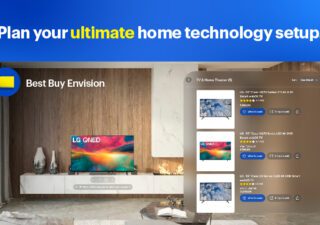
The retailer to beat in consumer electronics is often Best Buy Co. Inc., whose more than 900 stores entice, entertain and educate shoppers with extensive product displays and a helpful team of “blue-shirt” sales associates. Best Buy duplicates much of that experience—and adds more—online at BestBuy.com. For the fourth year in a row, Best Buy’s online store has been named to Internet Retailer’s Best of the Web Top 50 list of online retailers.
BestBuy.com emphasizes customer service by placing toll-free numbers on each page along with a click-to-call option to request a call from an agent. It also plays up friendly images of its blue-shirt store associates, leaving no doubt that it’s backed by the same service customers expect in stores.
This year Best Buy has expanded its online offerings in both products and service. It introduced with Velocity Micro, a manufacturer of high-performance gaming PCs, the ability for online shoppers to customize a PC to their particular gaming needs. Shoppers link from BestBuy.com to a Velocity Micro site to customize their PC, then click back to Best Buy to complete the purchase.
Best Buy also launched its own online music store powered by RealNetworks Inc.’s Rhapsody music service. Unlike most digital music stores, BestBuy.com offers shoppers the choice of downloading individual songs for 99 cents each or subscribing to a monthly service of unlimited music access for $14.99.
One area where BestBuy.com could improve, however, is in playing up these and other services on its home page, which emphasizes pricing deals but leaves much of its shopping assistance features on its internal pages, says Colleen Coleman, an affiliate of retail consultants McMillan/Doolittle. “They should hit shoppers on the home page with a message about how to choose a TV, for instance, making a balanced statement between ‘We have good pricing’ and ‘We can help you choose good products,’” she says.
But Best Buy continues to successfully move forward with sales and online innovation. In a new twist on customer service, for example, Best Buy now lets shoppers submit rebate forms online instead of through the mail—a feature that not only saves customers time and postage but gives them another reason to visit BestBuy.com.
Crutchfield.com
A drive to succeed
Don’t mess with success, the saying goes. With monthly traffic now grown to 3 million visits, Crutchfield.com, the online arm of auto and home consumer electronics cataloger Crutchfield, knows not to tinker with its winning formula of extensive product knowledge and top-notch customer service—except to keep burnishing it to even higher levels of performance.
Take two new applications developed by Crutchfield this year. Digital Drive-Thru extends Crutchfield’s knowledge base and customer service into new territory that mirrors consumers’ love affair with iPods by answering the question of how best to hook one up with their car’s sound system. Visitors using the online tool type in their iPod model—whether they already own it or want to purchase it on the site—and the make and model of their vehicle. They get recommendations on products and installation geared toward the combination that produces the best sound quality. To make that determination, Crutchfield leverages its extensive pool of product specifications as well as knowledge amassed internally over the years on in-car sound quality.
The concept builds on “What Fits My Car,” the still-popular tool launched online in 1999 that guides purchase decisions on the aftermarket installation of in-car audio equipment. In fact, the tools leverage the same underlying technology. So does another feature, an online TV Fit Finder—new this year—that juggles product dimensions to guide shoppers to the TVs that will fit into their existing home entertainment system furniture—or which furniture will hold their existing TV. To that selection Crutchfield now offers an expanded range of home theater furniture in partnership with furniture manufacturers.
“We’ve always been very customer service- and customer benefit-oriented, and this frames that up,” says Cruthfield.com senior director Andy Stevenson. Those tenets also support one of the industry’s largest databases on home and auto entertainment electronics, content shared with consumers through the Crutchfield Advisor site and in multiple locations and features on Crutchfield.com.
“Their knowledge of their category is the brand,” says Lauren Freedman, president of The E-Tailing Group. “They want you to know they know their stuff.”
Dell.com
PCs to go
The computer is more heavily researched before purchase than many products, and today much of that research happens online. Dell Inc. knows that very well—in fact, it helped create this pattern by developing one of the most content-packed e-commerce sites online, and then making it easy to use.
Experience has taught the company that the web is the most efficient way for it to provide customers with an infinite combination of products and services and the tools to help them make choices. “The value proposition online is in how user-friendly, informative and efficient it is for our customers to research and buy products and receive service afterwards should they want it,” says Kurt Kirsch, director of online consumer and employee purchase programs.
Expanded functionality helps ensure Dell.com a continued leadership position in the highly-competitive online retail marketplace for computers as well as the home entertainment equipment used with them. Assisted navigation added this year helps customers better browse Dell.com while a new “SuperConfigurator” further streamlines the process of assembling a personalized system.
Dell also is leveraging the web not only to inform customers and guide them through a potentially challenging purchase process but also to give them a public voice and strengthen their connections with Dell and each other. A customer testimonial feedback section in the home and home office section lets customers share experiences with Dell and other consumers; a new feature on product pages lets customers rate and review items online.
Further, the company has a new blog, direct2Dell.com, and syndicates blog postings and more on some 20 RSS feeds. The new Dell Community forum is evolving to connect visitors with the same interests, initially focusing on gaming, digital life and those in need of help with tech issues.
“Dell has done a really outstanding job of simplifying what could be a complex process for the customers to build their own PC,” says Chad Doiron, strategist in the Internet practice of Kurt Salmon Associates. “It makes it intuitive and straightforward. And with so many choices they do a great job of cross-checking and reconciling all the options.”
GameStop.com
The go-to site for gamers
The world of the video game retailer is one of great complexity. First there’s the technology: video games come in a wide array of formats for an ever increasing number of platforms: Nintendo Wii, PlayStation 3, Xbox360 and PC Games, to name just a few. Then there’s the type of game: action, puzzle, racing, role playing, sports, fantasy and many others. Then throw in the different age groups and sexes.
Meeting these needs is a formidable challenge, and GameStop.com is meeting the challenge—and then some. Operated by GameStop Corp., the world’s largest video game retailer, GameStop.com sells new and used titles ranging from “Tiger Woods Golf” to “Archlord: The Legend of Chantra.” It also sells hardware and accessories for game systems.
Trying to navigate a site selling so many different products can be tricky, but GameStop makes it easy for customers by giving them the option of searching by platform, says Shari Altman, president of consulting firm Altman Dedicated Direct. “The first thing is on what platform are you going to be playing your game,” she says. “Once you choose any one of those, it’s almost like there’s another little store that’s just Xbox stuff or Nintendo.”
However, the home page navigation doesn’t give customers the option of searching by different types of games, Altman says. “Maybe it’s because no one thinks like that in this niche, but it seems odd to me that you couldn’t get there either way.”
Another flaw, Altman contends, is that GameStop.com doesn’t have a Buy Now button until the customer drills down to the individual item. “A lot of games can be very popular, people already know what they are, they might be shopping on price,” she says. “Why make them click to more information. If you’re going to show a picture of something you can buy right there, why not let me buy it?”
But GameStop.com is unique from other e-retailers in the volume of customer reviews and ratings posted on their site, Altman adds. “You can sit and read through 10 or 12 different reviews on a product.”

JR.com
Manhattan star
Since Joe and Rachelle Friedman founded J&R Electronics in 1971, they’ve remained closely involved with the day-to-day details that have made their 200,000-square-foot store a retail landmark in New York City.
Joe still walks the sales floor every day to talk with customers and employees, learning first hand what it takes to keep shoppers coming back. Located in lower Manhattan, the store is frequented by Wall Street analysts researching trends in consumer electronics as well as by celebrities of film and politics.
Yet for all its big-city fame, J&R has shunned expanding its market through other stores—eyeing its growth instead through JR.com.
The site builds on the store’s reputation with a home-page link to its blog, RealNewYorkersKnow.com—where visitors can read ramblings on the latest electronics technology by J&R employees along with reports of in-store appearances by celebrities.
But the site also takes unusual steps in meeting other customer needs: A “Contact Manufacturers” page, for instance, lists the phone numbers and e-mail addresses for hundreds of JR.com’s suppliers. “We try to help out our customers as much as we can,” says Jason Friedman, vice president of e-commerce.
“J&R goes a long way in taking the mystery out of shopping,” says Maris Daugherty, senior consultant at J.C. Williams Group. “It offers tremendous product level content and several options on how to sort search responses including brand, title and price, and the compare function is easy to use and assists visitors in their understanding of some very complicated product specifications.”
But J&R isn’t sitting still. It recently entered a partnership with Macy’s to operate the consumer electronics section in its flagship Herald Square store in Midtown Manhattan—where a limited product line will be backed by an in-store kiosk that lets shoppers buy any of J&R’s products through JR.com.
In the first quarter of 2007, J&R will launch a re-designed JR.com. The new site will provide for more streamlined shopping with fewer clicks in the purchase process, improved site search and navigation, and hundreds of online videos of J&R store associates demonstrating products.
“We’ll do a lot of things to keep things exciting,” Friedman says.
Palm.com
‘Like the back of my hand’
E-retailers can learn a lot about effective e-commerce site navigation from Palm.com. A shopper who hits the home page of the site immediately receives lists of clear, simple choices to help him decide how to begin drilling down. From there it’s the very same method with each successive drill that gives a shopper ease and confidence—along with numerous detailed accompanying images and data—while finding precisely what he wants in mobile technology.
Along the way, shoppers—domestic and international—are presented in a crisp and uncluttered fashion a mammoth choice of online and downloadable brochures, product specifications, FAQs, technology glossaries, options, product comparisons, footnoted explanations of components and software, related accessories, and much more. It’s an information bonanza on the path to a purchase, with cross-channel support to retail stores. Further, the site caters to personal and business shoppers and presents information and choices in ways that are easily understandable by both information technology professionals and novices. Palm.com also offers a My Model section that customizes shoppers’ online and online navigation experiences based on the hand-held devices they own or are considering.
“It’s a very easy site to navigate,” says Sucharita Mulpuru, senior retail analyst at Forrester Research Inc. “The company deserves credit for this because few manufacturers are as skilled as Palm when it comes to navigating an e-commerce site.”
What’s more, the Owner Resources section on Palm.com is an excellent place for any Palm owner to spend quality time, adds Maris Daugherty, senior consultant at J.C. Williams Group Ltd. “Not only does it have valuable content for new Palm owners, its download section offers a thorough selection of ‘try before you buy’ downloadable applications available in numerous languages. Ultimately, Palm.com is a good example of e-commerce at work and play.”
TigerDirect.com
Clawing its way up
In the rough and tumble world of consumer electronics retailing, price and customer service are the primarily elements of success. Price is easy enough to understand, as low prices will always turn consumers’ heads. Providing quality customer service, however, can be an elusive concept for some retailers to grasp.
Taking a customer-first approach, TigerDirect.com has steadily clawed its way up the ladder since launching sixteen years ago to compete with the likes of industry giants BestBuy and CompUSA. The key to TigerDirect’s rapid ascent is that the retailer knows its customer base: in this case it is, in most cases, price-sensitive consumers who comparison shop and expect same-day shipment when an order is placed.
“Being dedicated to price and customer service is important in this category,” says Patti Freeman Evans, senior analyst, retail industry, at Jupiter Research. “This is a retailer that knows its customers and how to play to them.”
A major part of TigerDirect’s service strategy is to provide detailed content about the products it sells. This content goes beyond product descriptions to include order tracking through the site and a rebate center where shoppers can search for manufacturer rebates. Both sections are clearly marked on the navigation bar for greater ease of use. Shoppers also can sign up for a free e-mail catalog and e-mail alerts about specials.
“TigerDirect makes it simple to navigate their site, understand the offers available and compare products,” Evans says. “They provide the kind of information people need to make a solid purchasing decision.”
On another note, TigerDirect’s merchandising strategy is so effective that it has insulated the retailer from comparisons to larger competitors that aggressively promote online ordering and in-store pick-up—despite the fact it, too, operates bricks-and-mortar locations.
“In-store pick-up is something other multi-channel retailers are heavily promoting, but TigerDirect has shown it can provide what customers want, which is why sales are good,” says Evans.
Given its prowess at servicing the customer, the competition is paying close attention to TigerDirect’s roar.
YesAsia.com
Catering to customers
YesAsia.com is proof of the age-old retailing principle that success lies in knowing one’s customer and delivering what they want. What sets the retailer apart is its ability to create a sense of Asian community not only in its catalog of products but in its look and feel.
Shoppers can purchase from a catalog that includes Chinese, Japanese, Korean and Western entertainment items, such as CDs DVDs, books, comics and collectibles like concert merchandise. In addition, the site is written in five languages—traditional Chinese, simplified Chinese, Japanese, Korean and English.
“The site looks like one that shoppers would find only in Asia,” says Maris Daugherty, a senior consultant at J.C. Williams Group. “The color and design of the site look more like a commerce site found in Asia even though the site serves shoppers in several different countries. It is clearly focused on the needs of the Asian community.”
Equally impressive are the ease of site navigation and the depth of content. By clicking on an item shoppers can access a product description, lists of top sellers in the category, customer ratings, package deals, and other items bought by customers that purchased the item being viewed.
“YesAsia.com builds on a customer interface standard that has been successfully used by Amazon.com by providing super-rich content around the product catalog,” says Chad Doiron, a senior strategist for Kurt Salmon Associates. “That’s important, because as consumers become savvier in navigating web sites they expect richer content to be available.”
YesAsia.com recently has been focused on expanding its catalog to become a true mass merchandiser—it launched YesStyle.com in June to market apparel, shoes, bags, fine jewelry, accessories and other items to women ages 18 to 35. And the retailer has proven to be a shrewd promotional strategist—any order totaling $25 or more, for example, is shipped free. “That’s a big selling point considering that when ordering CDs or DVDs, the bulk of the cost can be shipping,” says Doiron. “Free shipping takes away a big impediment to placing an order.”